Monsoon Season

July Electricity Bill Check

Any DISCO, same reference number, same result: your july bill, pulled from the official PITC record so you can view it, download it, or print it below.

July Electricity Bill Check - Pakistan

July Electricity Bill Check - Pakistan

July adds monsoon humidity on top of summer heat, so AC load doesn't ease up the way it might elsewhere once rain starts — humid heat is often harder to cool through than dry heat, and July bills usually stay close to June's level. It works the same way regardless of which company bills you — MEPCO, LESCO, FESCO, IESCO, PESCO, GEPCO, HESCO, SEPCO, QESCO, TESCO, and HAZECO all run their duplicate-bill lookup through the same PITC-backed system.

Type the 10 to 14 digit reference number printed on your last bill into the box on this page and your July statement opens for viewing, downloading, or printing. No account, no login, no charge.

How the July billing cycle works

How the July billing cycle works

If your area saw monsoon flooding or an extended outage in July, your bill may show a lower unit count than expected purely because supply was interrupted for part of the cycle — not a discount, just fewer hours of consumption.

Outside of that, the mechanics are standard: the DISCO reads the meter, generates the bill in PITC, and it becomes searchable by reference number here within roughly two days.

Monsoon season impact on your July bill

Monsoon season impact on your July bill

Monsoon rain also brings intermittent outages in several regions, which complicates meter reading schedules — some July bills carry an estimated reading rather than an actual one if a meter reader couldn't access a connection during heavy rain. Check your bill for an 'estimated' flag if the unit count looks off.

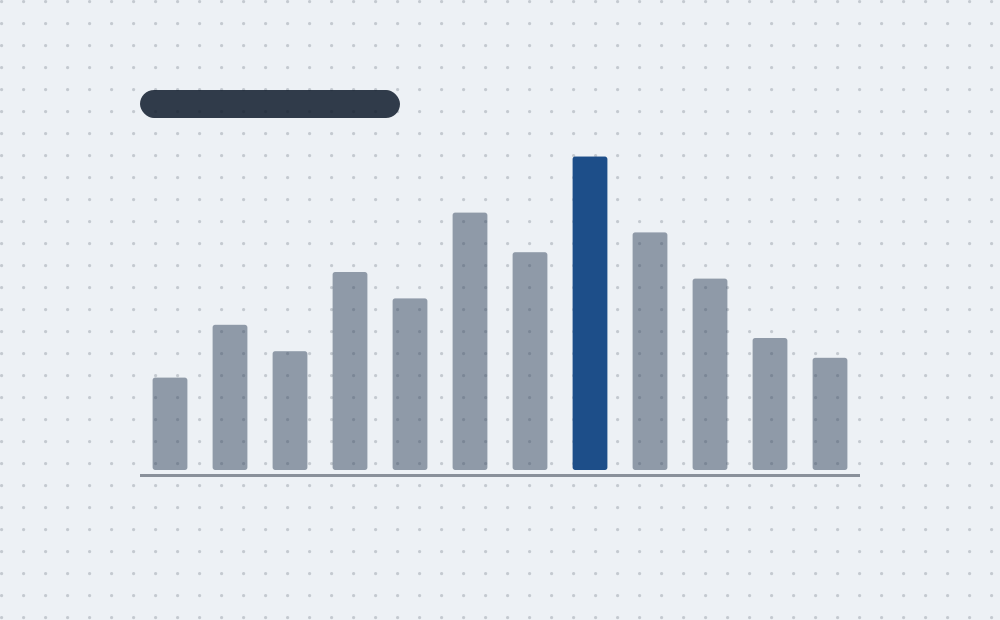
As a rule of thumb across the year: summer months (May through August) can double or triple a household's baseline consumption once AC use is factored in, winter months (November through February) push usage up through heaters and geysers, and spring and autumn (March-April, September-October) sit closest to the year's floor. Knowing where July falls in that pattern is the fastest way to tell whether a bill's size is expected or worth a closer look.

How to check your July electricity bill online

How to check your July electricity bill online

Checking a July bill takes the same four steps every time: find the reference number, choose your DISCO, enter the digits, load the bill.

The page pulls the official PITC record rather than an estimate, so the amount, due date, and arrears shown match what your DISCO has on file.

July electricity tariff and slab rates

July electricity tariff and slab rates

NEPRA sets a progressive slab structure for domestic consumers, and it applies to your July bill exactly as it does year-round: the first 100 units (the protected category) carry the cheapest per-unit rate, and each bracket above it — 101-200, 201-300, 301-700, and 700+ — costs more per unit than the one before. Cross a slab boundary and the bracket you land in, not just the extra units, drives the increase.

Commercial, industrial, and agricultural connections run on separate schedules from residential. Because NEPRA revises these rates quarterly, the safest way to confirm which schedule applied to your July bill is the issue date printed on it, not the month name alone.

FPA and surcharges in your July bill

FPA and surcharges in your July bill

If your unit count stayed flat but the rupee amount didn't, the Fuel Price Adjustment is the usual explanation. It tracks the real cost of the fuel used to generate power that month, so it moves with global oil, gas, and LNG prices rather than with anything you did differently — and it can land as an extra charge or, occasionally, a credit.

Layered on top of FPA and the base energy charge are a handful of standing surcharges: Financing Cost (covers sector debt servicing), a flat TV fee for residential connections, General Sales Tax on total consumption, and Tariff Rationalization. Together these typically add 15 to 30 percent to the base energy charge, which is why the bill total often moves more than the unit count alone would suggest.

How to pay your July electricity bill

How to pay your July electricity bill

Paying doesn't require the printed bill in hand — the reference number is enough for JazzCash, Easypaisa, NayaPay, or SadaPay, and for the mobile apps of most major banks (HBL, UBL, Allied Bank, Meezan, MCB), usually without a service fee. 1Link ATMs work too.

Prefer paying in person? Bank counters, Pakistan Post, and franchise outlets still take the physical bill. Miss the due date printed on it, though, and a Late Payment Surcharge of roughly 5-10 percent gets added on top.

Tips to reduce your July electricity bill

Tips to reduce your July electricity bill

Humidity means dehumidifying matters as much as cooling in July — running an AC on a lower fan speed for longer, rather than blasting cold air intermittently, actually removes more moisture and can feel cooler for less electricity.

Beyond what's specific to July, the one change that helps in every season is net metering: a rooftop solar system offsets daytime consumption year-round and can export surplus units back to the grid during peak sun hours, which is worth looking into regardless of which month you're reading this on.

Common July bill issues and how to resolve them

Common July bill issues and how to resolve them

Bill isn't showing up yet — if it's been fewer than 24-48 hours since the expected issue date, PITC probably hasn't received it from the DISCO yet; try again the next day rather than assuming something's broken.

Amount looks too high — the first check is always the previous month's unit count, not the rupee total. A sudden jump usually traces to a faulty meter, an estimated (not actual) reading, or an appliance that got left running; a call to your DISCO subdivision office gets a meter check scheduled.

Reference number won't work — it has to be exactly 10 to 14 digits, no letters, no spaces. Older meters occasionally get reassigned a new reference number during system upgrades, in which case your local DISCO office can confirm the current one.

Due date already passed — a Late Payment Surcharge applies from that point on and keeps accruing, so pay as soon as you can rather than waiting; letting it run risks disconnection.

Arrears showing on the bill — these are unpaid balances carried forward from earlier cycles rather than a new charge. Clearing them stops them compounding and avoids disconnection action later.

Support

July Bill Check - Frequently Asked Questions

How soon after the issue date does my July bill show up here?

Within 1-3 days on the PITC portal, once your DISCO has finalized it — it isn't instant, and there's no way to speed that part up from this side.

I don't have a reference number handy — can I still check?

Not through PITC's system, no. You'll need it from a previous printed bill, an SMS alert from your DISCO, or by calling your subdivision office.

Is what loads here the same as the original paper bill?

Yes — same line items, amount, due date, and taxes, pulled from the same record.

Why is my July bill higher than June's?

Almost always one of three things: a seasonal usage shift, an FPA adjustment, or crossing into a higher slab bracket.

Will a bank accept this duplicate for loan paperwork?

Many do, since it's the same official PITC record, but confirm with the specific bank first rather than assuming.

Does this site keep a copy of my bill or reference number?

No — the reference number is passed to PITC to render your bill in the browser, and nothing is stored on our end.

Comparing bills across the year is often the quickest way to spot whether a change is seasonal or something worth a closer look. Jump to any other month below, or use the home bill checker directly.

Each distribution company has its own landing page with office details, tariff notes, and a bill lookup specific to that DISCO.